It is the mission of the Florida Urban Forestry Council (FUFC) to promote the value, enhancement and sound management of urban forests through leadership, collaboration, guidance, and education.
The Council Quarterly Newsletter Article
Tree of the Quarter: Olive Tree (Olea sp) (Olea europaea)
Article submitted by Joe Anderson
Brief Intro: The olive is a subtropical evergreen in the family Oleaceae. Florida is olive-friendly. Though the olive won’t provide a commercial replacement for citrus, with the onset of citrus greening disease, it can provide a fruit tree alternative for ornamental landscapes, neighborhood food forest plantings, and other places looking to create diversity and curiosity.
Commercial Use in Florida
Commercially, olive production in Florida is in its infancy, but there are indications of a promising future. Olive farming is expanding in Florida and Georgia. Central and northern Florida are more favorable to fruit production and higher yields. Olive trees can thrive under the Florida sun. Success depends on location, variety, and proper care.
Olive Trees in the Urban Landscape
With regards to urban forestry, under the right conditions, the olive could be the right tree in the right place. Floridians can enjoy the ornamental beauty of a medium-sized, olive shade tree. In the modern urban landscape, olive trees offer fruitful rewards with attractive features to include distinctively gnarled trunks, evergreen silvery-gray foliage, and moderate size. The olive tree is being planted by the urban forestry team in Jacksonville, FL.
Compared to other fruit trees, olive trees are relatively pest-resistant, but high humidity can create a risk of fungal disease. Olive trees can be messy due to fallen fruit, leaves, pollen, and occasional oil drips, but the mess can be managed with proper care, placement, and planning. The main source of litter will be the dropping of mature fruit. The olives are high in oil, which can stain patios, driveways, and other surfaces. They can create slippery conditions when crushed or wet. Fallen, decomposing fruit can produce a strong, unpleasant odor on a hot, humid day.
Olive trees thrive in sunny, well-drained soils. Olive trees are hardy and can tolerate occasional frosts when temperatures remain above 20 degrees F. The winter climate of central and northern Florida can provide the cooler temperatures needed to meet the trees’ chill hours for flowering and fruiting. South Florida’s mild winters often fail to provide sufficient chill hours, leading to poor or inconsistent fruit production. The Arbequina and Koromiko varieties are the most heat-tolerant with lower chill requirements.
Pruning is important for maintaining a healthy structure and promoting air circulation and light penetration within the canopy.
Not all cultivars can cross-pollinate. Arbequina, Koroneiki, Frantoio, Fantoio, Coratina, and Picual varieties produce perfect flowers (both male and female parts). This enables them to reproduce through self-pollination, but cross-pollination will generally produce higher and more consistent yields of fruit.
Olive Tree Facts
Habitat: Thrives in hot coastal climate conditions. Olives are drought-tolerant due to a sturdy, extensive, and robust root system. They prefer dry conditions. Olive trees grow best in well-drained, sandy soils and require full sun. They are well-suited to central and northern Florida and perform best in USDA hardiness zones 8–10. Young trees may be vulnerable to frost. Olives grow best in a climate where the summer is long and hot, and the winter is cool.
Form: Short, squat, and spherical shape. The olive tree rarely exceeds 25–35 ft in height. The mature trunk is uniquely gnarled and twisted. With a dense and lush canopy.
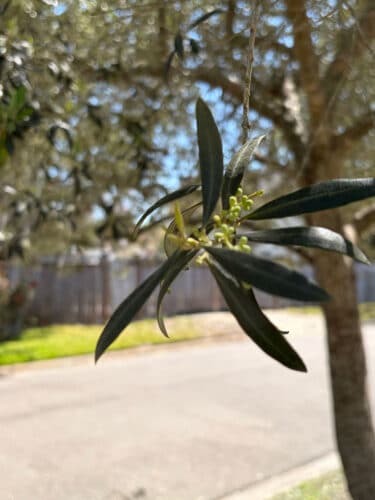
Leaves: Dark green top with a silvery underside. Leaves are oblong, measuring 1.5–4 inches long and 1.33 inches wide.
Flowers: The flowers are often numerous and highly odoriferous. Small, white to cream-colored flowers are borne generally on the previous year’s wood. In Florida, flowers bloom in April and May.
Fruit: Olive fruit is a small drupe. High nutritional and culinary value.
Uses: Ornamental tree, fruit, and oil production. Wood is hard and tough, but sought after by woodworking artisans for durability, color, and interesting grain patterns.
Little Known Facts: The olive is among the oldest domesticated fruit trees for commercial production of fruit. The olive has a symbolic and spiritual importance in various cultures. The oil extracted from the edible fruit has uses in food, lamp oil, soaps & cosmetics, lubricants, and medicine. The Seal of the United States, designed in 1782, depicts an eagle clutching an olive branch and arrows in its talons, indicating the power of peace and war, respectively.
Please let us know what urban forestry projects you have going on in your neck of the woods. The Florida Urban Forestry Council would greatly appreciate the opportunity to share your information in our newsletter. These articles can include:
New trends in the industry
News about tree advocacy groups
Volunteer projects
City tree programs
Letters to the Editor
Questions for “Stump the Forester”
We look forward to hearing from you on this or any other interesting topic related to the urban forestry industry and profession. Please send any articles or ideas to the FUFC newsletter editor. Thanks for contributing!